Thursday, May 28, 2020

Taking Control of Your Time


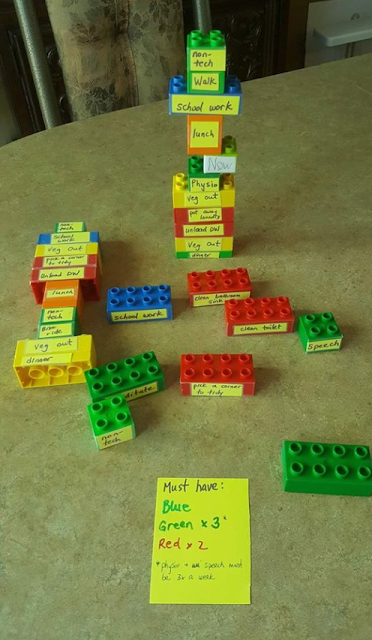
I want to give a shout-out to daughter Cindy today for her innovative, creative way of helping her kids, Luke (Grade 5) and Florence (Grade 3), manage their time.  Here's how she did it.

I created the labels based on what I want the kids to be doing. The kids get to choose what they do, and in what order but they have to have 2 reds (chores), blue (school work) and 3 green (self care). They get 2 yellows (veg out/ tech time). Luke wanted a 2nd blue as his school takes longer and he needs a 'green' break in between. So we tweaked it for him. Luke made a 'tracker' so he knows where he is in his schedule.

On a related note, a post came in from ADDitude Magazine recently entitled A Daily Schedule for ADHD Brains. Having read the article, I think there is advice in here for all of us, adults and kids. There are links within the article to more great ideas.

Here is a short summary of the article (and note how similar they are to Cindy's ideas.  Great minds!):

  1. Do something for your BRAIN.  Read a book, learn a new skill, dust off an old one.  
    1. Get your child to teach you be it a musical instrument, a computer skill, a new game.
  2. Do something for the HOUSE: cooking a meal, working on the home budget, gardening. 
    1. Work with your kids on some of these HOUSE events.
  3. Do something for your BODY.  Will it be a virtual yoga lesson, going for a walk or a morning/evening meditation?
  4. Do something for YOURSELF: self-care is truly important these days.  Will it be a soothing bubble bath, catching up with friends on Zoom, a favourite ice cream treat?  'You' time is not selfish; it's essential and medicinal.  No guilt.
  5. Do something for SOMEONE ELSE.  We need human connection more than ever.  
  6. Do something for your SPACE.  Doing small daily tasks provides you with small successes.
  7. Do something for YOUR FUTURE GOALS.  "Balance your focus between today and what comes next."  Even if don't know the 'when', but working toward future goals gives us some power and control to be ready when 'when' happens.

Finally, I leave you with the following post that appeared recently on my Facebook page:


Sunday, April 26, 2020

A Potpourri of Ideas to Help us Have Fun


Hello everyone.  I guess the long haul just got longer here in Ontario with schools closed to May 31.  At least the labour situation has eased.  Remember when teacher strikes were happening and how frustrating it was to have no school for a day every other week?

But on to other matters.  I've entitled this post a Potpourri because it's a miscellaneous collection of some ideas to have fun.

My daughters and John and I have been trying to have daily video conferences at the end of the business/school day.  But a week or so ago, my daughter Cindy, in Burlington asked if we could do a special grandparents' video time with Luke (10) and Florence (8) because they were missing their time with us!  So we set up a conference call on Messenger and played Tenzies.  It was a year ago that I wrote the original post about how much fun this game is.  I did buy the deck of 77 Ways to Play Tenzi and I have the set of four coloured dice.

Cindy doesn't have a Tenzi set but she did have a lot of dice from a game called Flash.  You could also raid all the games in your house that come with dice (just remember where they came from later!)

The kids got creative and figured out a way to make sure they had 10 dice of their own and we started to play - Luke and Florence in Burlington, I in Markham.  Note that we used place mats or towels to soften the sound of possibly 30 dice hitting a hard surface all at once!

It was so satisfying that we have now played twice!  

Oldest grandson, Cameron, introduced his mom to a virtual version of Pictionary.  So KC got us set up and it was our activity for our Saturday Family Game Night last night.

We had 7 laptops/tablets between the 8 of us with either a tablet or another window open on the laptop so we could talk to each other.  Highly recommended.

Along the same line (but with a trifle more challenging learning curve) is this site for playing card games.

John and I played Crazy Eights last night after the rest of the family left the video call - he at the desktop downstairs and I on my laptop upstairs.  Once we got the hang of it, we could see that it would be a good way to play together. Luke and John could play chess, but we want to play a game of Hearts first.  There is a good Help section; I think I was too eager to get right to playing the card game and didn't spend any time reading how to do it (think of that Executive Function that controls impulsivity and my deficit there!)

Cindy puts together the newsletter for the Science Teachers' Association of Ontario (STAO) and she found this Scavenger Hunt from the Perimeter Institute.  She was impressed and suggested I add it my blog!


And, finally, this just about sums up how it goes these days:

Hugs (virtually) to all.

Gerrie


Thursday, April 9, 2020

Buckets of Time


Today's post is a step-backward from my usual 'could-be-over-whelming' list things to do.  The following article in the Globe and Mail the other day could be helpful to those of you trying to juggle so many things.  This time, you can juggle buckets, and although it sounds like 'Filling Your Bucket', it might just be that by using these 'time buckets', you will be filling both your bucket and those of your kids.


Need to keep kids busy at home? Think 'buckets'. 

by Sarah Rosensweet
Globe and Mail, April 7, 2020.

By structuring days into different activity categories, you can provide a framework both for yourself and for your children.

You are not alone in wondering how to get through the days. There are many parents out there right now who are wondering the same thing (how to make it through the day). Many parents are in an unusual (for them) situation of caring for their children all day and every day. No daycare, no school. And to top it off, many parents are also trying to work from home. It’s helpful to remember that everyone is dealing with the same challenges right now and to give yourself some grace.

In terms of daily life with children at home, I like to think of structure in terms of “buckets.” A bucket is a category of activity. Every day we do at least one thing that falls into each bucket. Which buckets to include takes a little thinking and planning on your part. What is important to you and non-negotiable?

Buckets include things such as exercise, fresh air, reading time, independent play, chore time, schoolwork and social connection. These will be different depending on your family and your values. You might make a schedule if you are a schedule person. At the very least, I recommend using the bucket approach to give your life with children at home a sense of routine and predictability.

Children need predictability to feel safe and secure. Use three to five buckets to provide a framework for your day and refer to them when discussing the day with your child.
Here are some bucket examples and some tips for making them work.

MOVE YOUR BODY

Experts agree that exercise and fresh air must be included so we can stay mentally and physically healthy. There are lots of free resources available right now for keeping kids active. If you have a yard, get outside every day. If you don’t, open the window! This is also extremely important for caregivers. Move your body. Get your blood pumping. This alone can make a huge difference in your ability to cope.

EDUCATIONAL ACTIVITIES

If your children are school-age and you are pandemic-schooling at home, remember that the most important thing is to keep their minds engaged. It may or may not work for you to keep up with the assigned work. Remember that play is the work of childhood. If you are doing other things to keep your child’s mind active, such as reading with them, and you are not cut out to be their teacher, that’s okay. One of your buckets could reflect this, such as “brain games” or something similar.

INDEPENDENT PLAY

If your child is hesitant to play on their own, make sure to fill their cup/bucket first with some play time with you. When their connection needs are met, children are much more willing to play by themselves. A great way to encourage independent play is to set up some sensory activities, such as water or sand play. Again, Google has great ideas for sensory activities.

HELPING AROUND THE HOUSE


If you don’t already have a chore routine, start by asking older kids how they’d like to help out the family team. If you have younger kids, they can help out by being involved in daily household tasks such as food preparation, laundry and cleaning. If they get to spend time with you and get attention, children are usually happy to help out.

Finally, make sure to schedule some time for yourself. What do you need to do to stay grounded during this unprecedented time? Give yourself so much compassion. This is hard. It includes forgiving yourself for letting the kids have more screen time than you would normally be okay with. 

If we are to get through this with grace, we need to remind ourselves that these are not ordinary times. If you can, comfort yourself with the bright side of more time spent as a family. When things go back to normal, it’s possible we just might miss these days.

And along the same line of thinking, an update just came in from Understood.org called My Five Parenting Rules for Letting Go and Getting Through the Coronavirus Crisis.  Do check it out.  Her last point is awesome:

I always tell my kids they can’t do better than the best they can do. It’s advice I’m going to have to take right now. Amid all this uncertainty, my best isn’t as good as it typically would be. I’m distracted and worried, and it affects my productivity. But it’s still the best I can do. And I can’t do any better than that.


Saturday, April 4, 2020

April Showers


I'm just going to bypass all the usual thoughts we have these days, other than to say I hope you are trying to stay sane.  John and I are doing well; we teleconference almost every day with our daughters and their families.  My stepmom is by herself in Ottawa (how I wish I could 'rescue' her) but at this point, despite her saying that she's 'tired of herself' she is willing to stay on her own in her apartment.

Enough about me.  This will be a short post in terms of what you see from me but do check out this link for Wide Open School from understood.org.  I know we've been bombarded with lists of what to do with your child but this really is one of the best sites I've seen.  I've called this post 'April Showers' because showers in April bring things to life.  Fingers crossed the post gives you some cheerful thoughts.

"Understood has partnered with the best in education, tech, and media to launch Wide Open School. It's a free collection of the best online learning experiences and activities for kids curated by Common Sense Media to help families and educators adapt to online learning."


It is without a doubt, the best presentation of possible resources for you as an educator and/or a parent.  I've clicked on both being an educator and a family and the resources vary for the audience.  What I particularly like is that lists are not overwhelming.  Plus, it's a colourful setup.

Under 'educator' I found links to knowing how to use Google Classroom (as a parent you might want to check that out for more information).  I also found information on how to use Zoom - my go-to conferencing site for my tutoring sessions.  

In the same email that came to me from understood.org was a link to a diary written by a parent.  You might identify with some of her thoughts, especially if you have a child at home who learns differently!  


Finally, to both my parent readers and my friends who are educators (and there is definitely overlap) good luck with the upcoming assignments.  I hope the learning curve, just like the virus, levels off quickly.

Best to all,

Gerrie


Sunday, March 22, 2020

Learning at Home Part 2


This post started off far more complicated than it needed to be (those who know me wouldn't be surprised by that statement) so let's see if I have pared it down to the bare essentials!  I pulled many of the sites below from an ADDitude magazine email but thought better of including a truly detailed schedule. 

However, most of the sites I've been checking out recommend breaking the day into chunks for learning, chores, activities, your own work-from-home responsibilities, and personal breaks from each other.  Please do not dismiss any of the sites because the links refer to ADHD students.  ALL of the resources work for all students, all of whom learn differently.

Here's what cemented my decision to try to be simpler, from a recent National Geographic email:

“Any other parents totally overwhelmed by the amount of resources we’re getting now?” tweeted @JessGrose of the New York Times Parenting section. “I’m not a teacher and I still don’t know how to be no matter how many color-coded schedules and ‘helpful’ links I receive.”  
That’s why experts are urging parents to try to keep it simple when it comes to structuring their children’s days at home
So here's a curated list of suggestions and resources.  On a more personal note, I am learning about many resources that will help me as I tutor!

Physical Activity


  • YouTube Exercise videos
  • Write Happy Messages on the sidewalk as you walk
  • Check out Neighbourhood Window Walks; adapt it to become a personal Scavenger Hunt (i.e., how many houses still have Christmas lights up - no judging; how many spring flowers can you see on the lawns?)

Reading


Writing

  • ABCya - "ABCya provides over 400 fun and educational games for grades PreK through 6. Games are categorized by grade and subject, and cover topics such as multiplication, parts of speech, typing, pattern recognition, and more. We even have games that are just plain fun (and safe) to play!"

Social Studies


Math


  • Check YouTube for MathAntics for video instruction on a variety of math topics.  Of the many math video series this is one of the most professional.
  • Check out an earlier post of mine to find games and apps to help all students.  Scoll down past the section to Dyscalculia.   Math Apps
  • Illumination – From the National Council of Teachers of Mathematics - this is a rich resource from the American math teachers' website.
  • Mathies Games is on the Ontario Association of Math Educators website. The Mathies site is designed for students and parents, K-12.
  • TVO Mathify - this is a tutoring website and it now includes Grade 6 - 12.  Tutors are available Monday - Friday, 9:00 a.m. - 9 p.m. and Sunday, 3:30 p.m. - 9:00 p.m.

Science


Miscellaneous

  • Typing.com - click on 'Students' and watch the video for why we learn 'typing' or keyboarding.
  • Best game yet - Tenzi
  • 101 Screen-free Activities - it's rather ironic that I have to use screen-time to share these ideas, and you have to use screen-time to view them.  And who knew that May 4-10, 2020 is Screen-Free Week.  We'll see how that goes!
  • Mo Willems – the beloved children’s author and illustrator will lead doodle sessions each day at 1 pm EST
  • USA National Gallery of Art – lessons and activities - don't let this become too overwhelming, but there is a lot of material for discussion and trying.  It is really a very rich site.
  • TIME for Kids - Check out the sample articles from different editions.  "TIME for Kids engages students with authentic journalism, inspires them to join the national discourse on current topics, and provides teachers with valuable resources for the classroom.
  • 37 Amazing Craft Ideas - this is so not me, but it's all about diversity!


Tuesday, March 17, 2020

Learning at Home


Without preamble, here is a curated list of possibilities and resources for those with children at home for the next few weeks.  I will continue to add to this list as I find more. Please share this and share with me any other resources you are using.  

1. A SCHEDULE


This schedule was created by Jessica McHale @Jessica McHale Photography and was added to a Facebook page called Active Parents Burlington.  The author has many ideas for the GTA but I thought that many of you would appreciate having a schedule to structure your day.


2. How to Talk to Your Children

Some key points from a couple of sites that have been recommended:

  • Focus on the facts, understand the fear.  Don’t try to predict the future or share Doom’s Day scenarios with your children. Projections aren’t helpful when no one knows for certain what’s ahead, and trying to guess may cause anxiety to run rampant.  
    • Not talking about something can make kids worry more.  
  • Acknowledge and manage your own anxiety.  Easier said than done but try some of the relaxation strategies we keep hearing about: softening the face and jaw muscles, dropping the shoulders a bit, and taking a few deeper breaths. Then you can have a conversation with your kids.
  • Start with a question.  Follow with facts.  Let your kids tell you what they are worried about.  Don't volunteer too much information. 
    • You want to be prepared to answer (but not prompt) questions. 
    • Use the wealth of information on the Canadian government website.  Be wary of social media!
  • Limit news exposure. "Seeing images of people wearing masks in hospital wards and hearing coronavirus news reports all day long can increase distress in anyone. Experts say it’s a good idea to decrease your viewing time in common family areas of your home. Be mindful of little ears playing nearby that overhear news reports you’re watching or hearing."
  • Don't overshare. The best thing you can do is reassure them that responsible adults are working hard to keep everyone safe and healthy. You can also point out that experts say that being at home is the safest place to be. Hearing that home is the safest, healthiest place to be is the most reassuring message your child can hear.  
    • Focus on what you're doing to stay safe.
  • Maintain a routine.  See #1!
  • Try to play - and laugh. Board games, baking, hiking.

3. Canada's History Magazine for Kids


Check out the digital issues of Kayak: Canada's History Magazine for Kids and their complementary educational resources. These lesson plans are designed for students in grades 2-7, but can easily be adapted for older and younger audiences.

These magazines are exceptionally well-done and to have access to the PDF version is terrific.

There's also a Kayak Kids' Illustrated History Challenge (deadline June 15, 2020) for kids aged 7 - 14.  

4. Scholastic 


Check out what Scholastic is offering for all grade levels.  
Note that the website directs you to the US Scholastic.  There's still lots to do but it is not Canadian.  

5. Websites to Explore the World (and beyond)

a) San Diego Zoo 

This is one of the most colourful sites I've seen.  So much to explore and have fun with.  Lots of activities and games.

b) Explore the Surface of Mars

This site has potential.  Explore using the 'About' over in right hand corner.

c) Farm Food 360

So many VR tours and 360 tours with details on how to use different devices.  A good Canadian site inviting you to a variety of farms.  

Flip through the current magazine, virtually.  So much information!

d) Discovery Education

Learn about Polar Bears in this well-done experience.  "Since 2010, Discovery Education has teamed up with Polar Bears International to host a series of shared learning experiences to engage students and inspire their interest in studying the science of polar bears and their Arctic habitat."

e) Louvre


Visit the museum's exhibition rooms and galleries, contemplate the façades of the Louvre...
Come along on a virtual tour and enjoy the view, thanks to the sponsorship of Shiseido.


I've been recommending the JUMP at Home program for a while; books for all grades are available at  Mastermind and Amazon and they are about $18 - $20. They might help to keep kids up to date on some aspects of the math curriculum.

7. Math Card Games